Our Research
Ayaz Lab is focused on neuroergonomics and neuroengineering for brain health and performance research. We develop and apply wearable neurotechnologies, mobile neuroimaging, multimodal physiological sensing, and behavioral methods to investigate human brain function in realistic and real-world environments. Our research spans the human lifespan and includes both healthy individuals, from typical to specialized populations, and people with diverse clinical conditions, ranging from mental health to neurological and developmental disorders.
A central goal of our work is to move beyond traditional laboratory-only paradigms and study the brain in action, during everyday tasks, complex human-machine interactions, and natural social contexts. By combining neuroscience, neuroengineering, psychology, human factors, and biomedical engineering, we seek to better understand how brain function relates to behavior, performance, health, and adaptation in the environments where people actually live, work, learn, and interact.
Methods and Technology Development
A major area of our research is the development of methods for mobile and wearable neuroimaging. We work across the full research pipeline, including system development, experimental design, software tools, signal processing, data analytics, and machine learning. Our goal is to advance robust and practical approaches for measuring brain function outside conventional imaging settings and to make these technologies more useful for real-world and translational applications.
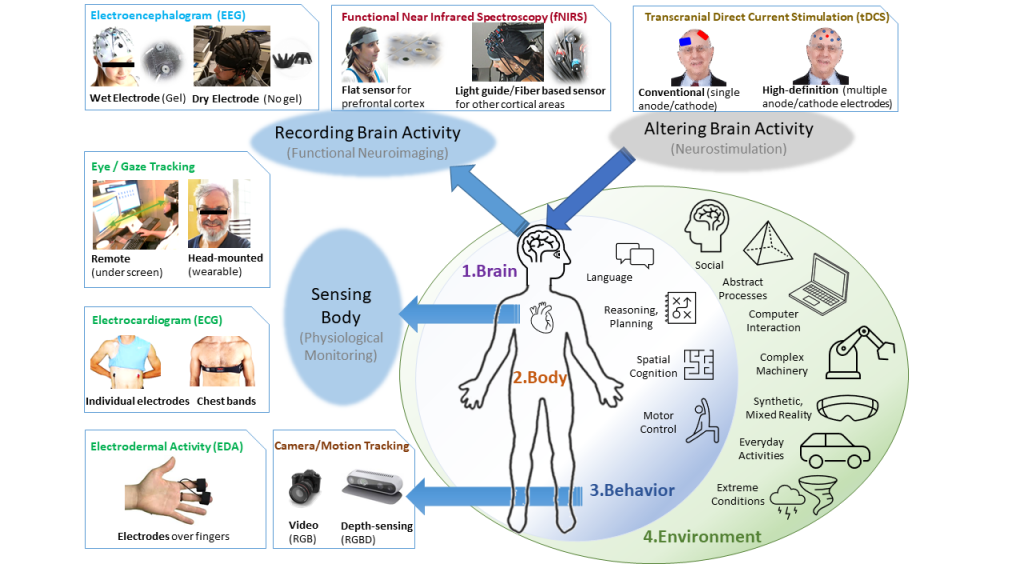
We are especially interested in multimodal approaches that integrate brain, body, and behavior. These include wearable neuroimaging platforms, physiological sensors, neurostimulation methods, and computational tools that support data fusion, interpretation, and deployment in realistic settings.
Clinical and Translational Research
We apply these methods in collaboration with clinicians and domain experts across a wide range of clinical and translational areas. Ongoing and recent work includes studies in autism, Down syndrome, concussion, eating disorders, and addiction, among others. Across these areas, we aim to better characterize brain function, identify meaningful biomarkers, and support improved assessment, intervention, and monitoring.
Our translational emphasis reflects a broader mission: to ensure that advances in neurotechnology and neuroimaging can inform real clinical needs and improve outcomes for diverse populations.
Human Performance in the Real World
In addition to clinical research, we study human performance in demanding real-world and operational settings. These efforts include research on cognitive workload, complex machine operation, training and skill acquisition, aviation, medical training, human-computer interaction, human-robot interaction, human-human communication, social interaction, hyperscanning, and teamwork.
Through these studies, we investigate how brain and physiological signals can help reveal the mechanisms underlying attention, effort, communication, coordination, learning, and performance under realistic conditions. This work helps inform the design of safer, more effective, and more human-centered technologies, systems, and environments.
What is Neuroergonomics?
Neuroergonomics is the study of brain function in relation to behavior, performance, and everyday life in real-world contexts. It addresses a fundamental limitation of many traditional neuroscience methods: although laboratory-based neuroimaging has generated tremendous insight into the human brain, much of that work has been constrained to artificial settings and simplified tasks that do not fully reflect the complexity of real life (See refs 1-6).
Neuroergonomics seeks to bridge that gap by studying the brain in the wild. The field focuses on understanding brain activity during natural behavior and unrestricted tasks, and on examining how brain function interacts with the body, behavior, tools, technologies, and environment. In this sense, neuroergonomics extends beyond the isolated study of neural signals and instead embraces the broader brain-body-behavior-environment system.
As an interdisciplinary field, neuroergonomics draws from neuroscience, neuroengineering, psychology, ergonomics, human factors, and cognitive science. Its rapid growth has been enabled by advances in wearable and mobile neurotechnologies, along with new computational and analytical approaches that allow researchers to collect and interpret data in real-world settings. Together, these developments make it possible to investigate human cognition and performance with greater ecological validity and greater translational relevance than ever before.
Wearable and Mobile Neuroimaging
A key driver of modern neuroergonomics is the evolution of portable neurotechnology, from wearable to mobile and increasingly ultra-mobile systems that can be used in realistic and field settings. These tools make it possible to measure brain activity during natural movement, social interaction, and complex tasks outside conventional imaging laboratories. Ayaz Lab contributes to this growing area through the development, validation, and application of wearable and mobile methods for studying brain health and performance in the real world.
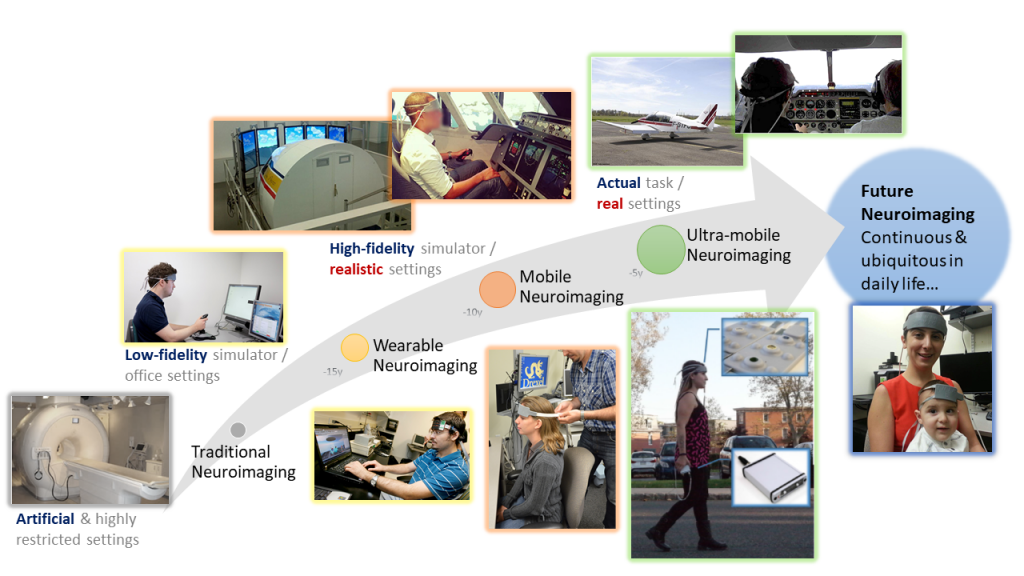

Wearable neuroimaging can monitor brain activity in increasingly diverse settings. Illustrations from recent studies (7)
References
1. H. Ayaz, and F. Dehais, Neuroergonomics: The Brain at Work and Everyday Life, 1st ed., Elsevier Academic Press (2019).
2. R. Parasuraman, “Neuroergonomics Brain, Cognition, and Performance at Work,” Current directions in psychological science 20(3), 181-186 (2011).
3. M. I. Posner, “Expanding horizons in ergonomics research,” Neuroimage 59(1), 149-153 (2012).
4. H. Ayaz, and F. Dehais, “Neuroergonomics,” in Handbook of Human Factors and Ergonomics G. Salvendy, and W. Karwowski, Eds., pp. 816-841, Wiley (2021).
5. F. Dehais, W. Karwowski, and H. Ayaz, “Brain at Work and in Everyday Life as the Next Frontier: Grand Field Challenges for Neuroergonomics,” Frontiers in Neuroergonomics 1(1), (2020).
6. A. Curtin, and H. Ayaz, “The Age of Neuroergonomics: Towards Ubiquitous and Continuous Measurement of Brain Function with fNIRS,” Japanese Psychological Research 60(374-386 (2018).
7. H. Ayaz, “Harnessing neuroergonomics: integrating wearable neurotechnologies for enhanced human performance and experience”. Neural Interfaces: Elsevier; p. 145–59 (2025).